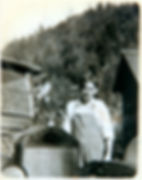
Earl Edward Callahan was born on February 17, 1923. That spring the family returned to Quartzburg, and by summer Ed decided it was time they owned a car. The mines were still running, distances were long, and a growing family made travel by wagon increasingly impractical even if Ed didn't know how to drive a car.
Years later their daughter Lois wrote down the story of her father’s first car exactly as she remembered it.
Dad’s First Car
By Lois Callahan Martel
Dad went into Boise alone from Quartzburg to buy our first family car. He found an old Overland 90 touring car and made the purchase. My father didn't know how to drive, so he had made arrangements to meet a friend in Boise who would drive the automobile back to Quartzburg with him.
The fellow let Dad drive a short distance just out of Boise, but as soon as the road narrowed and began climbing, Dad gave up the wheel to the experienced driver.
The friend promised to take Dad out for a few lessons in the days following but never returned.
Aunt Olive and her husband Arlin Howell had recently moved into an abandoned homestead near Centerville to be close to Babe and Carl Nisson, so one evening after Dad came home from work he suggested we go for a visit. Mom agreed and I was thrilled. We were finally going to have a car ride!
Mom mentioned that maybe Dad should have another practice drive, but Dad said he could drive the d__ thing.
Dad got the car out and almost into the driveway, but it required backing up a bit. The roadway was narrow—in fact the whole street was narrow, running between two hills with a brisk little creek dividing it right down the middle. The sides of the creek were built up with four logs stacked one on top of the other along each bank.
He headed our “new” car into the drive, looked at his excited family on the porch, looked back to where he had to maneuver his vehicle in order to avoid hitting the porch, and eased out into the road. He looked at us again, moved cautiously in reverse, looked at us briefly once more, still moving directly toward the creek.
Mom yelled, “Watch out! The creek!”
Dad was watching, but when he stepped on the foot brake he mistook it for the gas pedal and, with a loud ca-chunk, he high-centered on the log embankment. The rear wheels were spinning over the water and the gas tank was resting on the opposite wall of logs with the front wheels still on the roadside.
Dad looked up at Mom with the cockiest expression, like he had done exactly what he intended to do all along.
Mom and Dad started laughing, though I was the last to join them.
Dad did remember to turn the motor off and climbed out of the car to a highly amused audience. The superintendent of the mine, who lived across the creek from us, knew that Dad had never driven before and had watched the whole scene unfold. He yelled for one of the neighbors and told him to get a company truck to pull Ed out of the creek.
They attached a pulley to the car, and several men climbed into the creek to guide the rear end until the wheels were once again on the road. Undaunted, we all piled back into the car and off we went. Auntie and Uncle Arlin had their kids in bed when we arrived, but it was a beautiful moonlit night and the ride was wonderful. We had a very cautious driver, but not a single problem—and Dad never did need another lesson.
Before summer was over, Ed took time off and drove his family to Shoup for a visit. Annie and Bill Taylor, having sold the ranch around 1919, were living in Ulysses near Alta and Peter Barton and their seven children. Ed and Nora showed off their growing family, and the children saw the downriver community where their father had spent his boyhood — its river bends, weathered buildings, and the place that had shaped him long before they were born.
In the early 1920s Ed felt fortunate to have steady work in Quartzburg for another two years, even though metal prices were stagnant. Mine operators adjusted by shortening shifts. Women stretched gardens, wages, and patience in equal measure. It was a rehearsal of harder times to come, yet Ed and Nora got by frugally and happily.
Nora’s sister Olive and her husband Arlin Howell, now with three boys, were still living in Centerville just seven miles away, and both families were expecting another child. Shortly before Nora was due, Ed and Nora moved down to Boise, where Lorne Elmer Callahan was born on March 8, 1925.
By summer Nora was struggling. She had not fully recovered from the birth and required surgery. Afterward, she and the children went to Hailey so she could regain her strength. There were aunts and uncles there, and their beloved grandfather Bill Williams who could help with the children. Lois took over much of the care of Earl, who had been barely a year old when Lorne was born.
During that period Ed worked at the Golden Age Mine about forty miles northeast of Boise.
Lela's husband Frank Jackson was especially fond of Earl. When Frank came home from work he would lift the Earl on his shoulders and head off down the street. The months passed slowly for Nora, who had little energy beyond caring for baby Lorne.
In October Frank died of a heart attack. At the funeral Aunt Lela lifted Earl into her arms and carried him to the coffin. Earl, young as he was, never forgot it. It became his first memory, fixed forever: seeing his beloved Uncle Frank lying dead.

Not until early spring of 1926 was Nora well enough to join Ed in Pioneerville, a mining town some twelve miles over Grimes Pass. Centerville and Quartzburg weren’t far off, but mountain roads had not yet caught up with modern automobiles. Every journey in those mountains could be treacherous.
Nora later said she was not sure how they would have managed without Lois that year. Earl looked to Lois if he was hungry, needed a cuddle, or wanted to play outside. Lois, meanwhile, had begun attracting attention from boys. Earl loved the attention they gave him, but when Lois and the boys headed to town without him he cried inconsolably.
Turning to his mother, he would plead, “Caw Lois! Caw Lois!”
When it was time to move to another mining camp, the family could take only what would fit into the Overland, which mostly held the six of them. The car’s tires punctured easily and flats were part of the journey. A dog claimed the running board as its perch, and if it slipped off on a rough stretch of road Ed stopped without complaint so it could scramble back on. Some grades were so steep and narrow that everyone fell silent, holding their breath as the car crept upward or eased down the far side.
It was a nomadic life much like that of other hard-rock mining families of the day. Mines were small and worked only as long as a vein held ore. Families moved into camp for a year or two and when the vein “petered out,” as miners said, they moved on.
They did not have much, but they had what they needed. Ed worked wherever there was an active mine, making a new home in the camps scattered through Idaho’s mountains above Boise.


At one camp a tethered horse became tangled in its rope and barbed wire fencing, falling with one leg wrenched beneath its chin. When Nora came upon the animal it was exhausted and helpless. She ran back to the cabin and returned with the largest butcher knife she owned. The children followed—Lois carrying Lorne on her hip while Eleanor kept Earl at a safe distance. The girls were frightened, knowing that if the horse tried to rise at the wrong moment their mother could be badly hurt.
By then the horse had been reduced to a trembling mass of quivering flesh and seemed to sense that the woman with the knife meant no harm. It lay still as Nora cut rope and wire away piece by piece. When the animal was finally free, the girls were sure that their mother was the bravest, kindest woman that ever lived.
In late summer of 1927 word came that Ed’s mother, Annie had died. Ed lay face down on the bed and stayed there most of the day. The children grew uneasy because their father was never one to lay in bed in the daytime.
After Annie’s death the family moved toward Salmon City. Bill Taylor was overhauling the stamp mill of the Queen Ann mine and had a job for Ed. Stopping first in Ustick, Idaho for a days-long visit with Olive and Arlin Howell. Earl and Erwin, both about five years old by then, were delighted to be together again. The night before the Callahans were to leave, the boys were playing around and poured sand into the Overland’s gas tank. It earned them sore bottoms and two more days to play while Ed flushed the tank and fuel lines
Next stop was Hailey. By that time Lela had married her husband Frank’s widowed brother, Arthur Jackson. After a few days in Hailey they headed to Salmon where they rented a house and Ed worked out with Bill. Lois attended high school in Salmon and most Friday afternoons when Ed came home from the mine, everyone squeezed into the Overland and headed downriver.
Alta Callahan Barton had divorced Peter Barton in 1923 and moved from Ulysses to Shoup, where she kept a small home and boarding house for miners and tourists. The Callahans were not the only family making the weekend journey. With improved roads and more automobiles people from all over the county traveled to Shoup for the weekend dances. The community, long isolated, had become the place to go where a person could step back in time, step onto a dance floor and dance all night long.
The children had their Barton cousins, and the cousins had burros. Lois thought the dances were romantic, but best of all, it was the place their father called home.