Long Crossings, by S.E. Crie
Chapter Seven
Dodging Bullets and Signing Pay Rolls
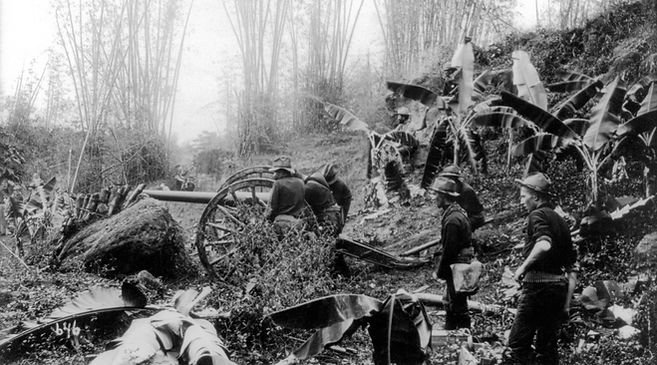
Manilla 1899. Public Domain
"American columns pushed north, east, and south from Manila to split the insurgent forces and seize key towns. Brig. Gen. Lloyd Wheaton's column pushed out of Manila, gained control of the Pasig River in March, permanently interrupting communications between insurgent forces in north and south Luzon." --U.S. Army Center of Military History
April 17, 1899, Anaconda Standard
SOLDIERS IN MANILLA
James A. Callahan Writes About the
Montana Boys There.
BUSY DODGING BULLETS
The Insurgents Are Very Treacherous.
Not much Fighting Lately—Lieutenants Greenan and O’Leary
Are Well Liked by the Men.
____
Private James A. Callahan of Company K, 1st Montana, writes the following letter to the Standard from Manila, under date of March 1. It reads as follows:
To the Editor of The Standard
February 21 opened up warm as usual, with all hands of the firing line in the trenches, with an occasional fire from the enemy, mostly sharpshooters,[1] who are either cross-eyed or close their eyes when they shoot. Their shooting is not very effective any more than to make the boys keep below their trenches.
February 22 was another quiet day on the line. At noon they were firing the salutes of the nation in the bay in honor of Washington’s birthday. At 3 p.m. Company K changed positions on the firing line and are now in the main support of the regimental headquarters. We had a good night’s sleep in the trenches with no disturbance.
On February 23, at 6 a.m., the trouble for the day began by an uprising of armed insurgents in the city of Manila, who were about to take possession of the railroad, which would have caused our forces a great inconvenience, as it would have cut off our communication and transportation of supplies and ammunition.
Company L of the Montana contingent was sent back to the city to assist in the protection of life and property under the command of Lieutenants Bradshaw and French. They were fired on by the insurgent mob as soon as they reached the city limits, in which Lieutenant French lost his life and several others were wounded.
While they were having their little trouble in our rear we were having ours on the front. The enemy treated us to a surprise party this morning by throwing three shells over our lines from a heavy gun they had mounted the day before. We could plainly hear the shells go over our lines and we were under the impression that they were still going, for no one heard them explode or drop anywhere. They then formed a skirmish or firing line skirting the timber. They were entrenched in for the purpose of doing battle with us, undoubtedly with the expectation of assistance from the armed forces of the city coming out and attacking us on the rear, but in that they were foiled by the shrewdness of our officers, who never sleep or are never caught napping. The enemy was driven back by our outposts.
Our lieutenant, Phil Greenan, received a very complicated or dangerous wound if it had not been for the revolver which he carries in a holster on his hip. The ball struck the butt of the revolver and was thrown out of its course and cut across his ribs and caused a very slight but painful wound. I think Phil is good for the balance of the campaign when he escaped the leaden messenger. The insurgents have kept up a continual fire on our trenches all day and night, keeping us very close to our work and the weather is very hot to live in trenches.
The transport Scandia[2] arrived in port from Frisco with the 20th regulars U.S.A., the first to arrive since August last. The troops here at present cannot advance much further, as the line extends in length 22 miles across the island, which makes the line very thin without enforcements.
On February 24 everything was quiet along the line with but a little bit of kick among the boys in regards to their menu for the day. There was no meat. It consisted of rice and apple sauce for breakfast, apple sauce and rice for dinner, and as lead was not thrown too promiscuously around the cooks they cooked us some rice for supper for a change.
February 25 opened up with heavy firing along the line, mostly between the outposts of both parties. Our outposts were annoyed by the enemy trying to advance upon them.
February 26 was very quiet along the line with the exception of an occasional exchange of shots by the outposts.
February 27 was also very quiet all day. At 7:30 p.m. the insurgents tried another shell at us from their large modern gun, but, like the balance, the shell went over the lines and for all any is aware of it may be quarantined at Hong Kong, for it was going in that direction when last heard from.
February 28, the last day of the month, was muster day, a day that is always looked for wistfully, as it is muster for pay. So between dodging bullets and signing pay rolls the boys were kept very busy that day.
The most notable feature of our campaign life is the remarkable degree of quickness displayed by our cooks in getting up a meal for us. A meal that would require anywhere from two to four hours to cook can be cooked in quarter in that many minutes,[3] for when one or more of them steps up to the fire to look at the cooking they are reminded by the familiar sound of the little leaden messengers[4] thrown at them by the rebels that they are not to stand around their fire much and the way they have of side stepping and ducking is worth seeing. They claim themselves that they are getting round shouldered from dodging bullets.
One of our boys, a private in Company K, was slightly wounded yesterday afternoon by being shot through the leg.
Lieutenant Greenan has reported back to our company for duty after a few days’ lay-off caused from his wound. Lieutenant Myles Kelly is doing temporary duty now with our company while on the field, as his Company H of Kalispell is doing guard duty at our Manila quarters. Lieutenant Arthur O’Leary is still with Company M of Anaconda. Both young gentlemen are held in the highest esteem both by the boys and officers of their respective companies.
I must now close for at present, as the cook has just called supper.
Montana Casualties to date:
Killed, seven.
Wounded, 43.
NOTES
[1] The “sharpshooters” James mentions were Filipino riflemen, often poorly equipped and trained, but skilled in using the cover of timber, stone walls, or trenches. U.S. volunteers sometimes mocked their accuracy, though even stray fire forced men to keep their heads down.
[2] The transport Scandia was originally a German passenger liner, seized and repurposed as a U.S. Army transport. Its arrival in Manila with the 20th U.S. Infantry Regulars marked the first substantial reinforcements since the summer of 1898—critical for holding such an extended defensive line.
[3] James likely meant “in a quarter of that many minutes,” a soldier’s shorthand for the speed with which cooks improvised meals under fire.
[4] Leaden messenger, common slang among U.S. volunteers for bullets; James uses it wryly here for the constant harassing fire in the trenches.