Long Crossings, by S.E. Crie
Chapter Two
Down the Salmon River
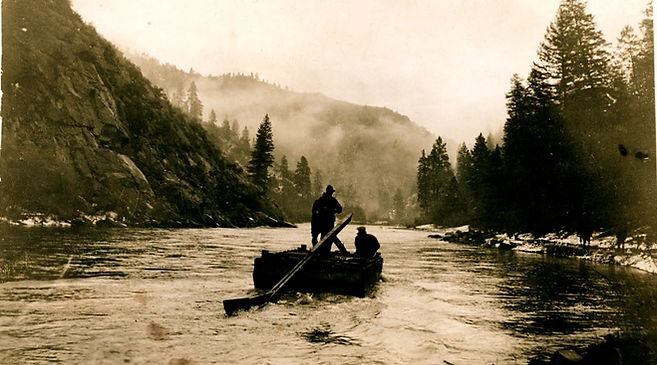
Salmon River freight boat near Shoup, Idaho.
“Prior to the date of 1881-2, quartz mines were unknown in this locality, but in 1868-9 or thereabouts straggling parties of placer miners, had each by an alternate pendent route, found their way across the mountains from Leesburg to bars on the Salmon river—and by washing wherever ‘pay’ could be found—they took the primitive steps in mining operations here.” —Annie C. Callahan
If James Callahan were alive to speak to us today …
We’d met our boatmen not long after we’d arrived in Salmon City that autumn of 1886. Eli Suydam and George Sandilands were building a scow beside the river just south of Main Street..[1] Annie flitted about town meeting John Booth, editor of the Idaho Recorder, merchants and hoteliers, even the school teacher. In the evening she told me about every person she’d met and every errand she’d crossed of her list. Between us, we gathered more information about the people we’d soon meet and the mines that employed them.
Annie and I were just children when placer gold was first discovered in the remote mountains of Lemhi County in 1866. The strikes weren’t on the scale of California’s gold rush, but they drew thousands of fortune seekers from across the country, most of them funneling into Idaho’s high country—especially to a place called Leesburg that lay thirty miles west of Salmon City. During the first year of discovery the “great rush” brought as many as 7,000 people, though the number dwindled quickly. The Chinese came to re-work diggings. Twenty years later only a couple of hundred remain in Leesburg, while Salmon City itself has its own Chinatown.
From Leesburg prospectors followed ancient trails and found free gold in the gravels along the Salmon River. With picks, shovels, sluice boxes and hydraulics, they stirred up enough shine to warrant a new camp along a creek someone dubbed Boulder.
At the end of 1881 quartz gold was struck downriver at a claim called the Grunter. In 1882, Sam James uncovered more: the Lost Mines, then the True Fissure on Pine Creek, the Spring Lode and lastly—but certainly not least—the Kentuck. Before that year was out the Grunter mine was in operation. The canyon rang with the sound of picks, shoves dynamite, the first stamp mill.[2] and dreams of hundreds of miners.
When a post office was established the name Boulder had already been claimed, so the town was renamed Shoup in honor of George L. Shoup.[3] Getting supplies into that canyon was another kind of madness. At first only pack trains could make the trip. Then came the freight boats.
As Annie would later write of it:
“On the first day of December 1882, five men and fourteen gallons of whiskey embarked with a cargo of 7,000 pounds of supplies, which they safely landed on the tenth day out. Now two men will make the trip in two days with a cargo of 24,000 pounds, but whether the quantity of whiskey is decreased in the same ratio as the number of men required, we are unable to state.”[4]
Once a scow proved it could haul three times the weight in a fraction of the time, everything changed. Boats got larger, mines developed faster and prospectors weren’t always disappointed.
Our first day on the river passed quickly and without mishap. There was just enough whitewater to give me pause while Annie embraced the thrill she expected. We made camp before reaching the mouth of the North Fork of the Salmon. Annie baked biscuits, fried the trout we’d caught along the way and bantered with the boatmen. I urged her to sing and she didn’t need me to ask twice. We slept under a canvas stretched over the boat, beneath quilts sewn by Annie’s own hand—though I cannot say I slept easy. The boatmen had filled our ears with stories of the canyon ahead and the river made a sound of its own.
Annie was awake before dawn, a fire already roaring on the shore with the smell of bacon and potatoes filling the air. She’d braided and tied up her hair, looked rested, happy and gave me a wave. Our captain handed me a fishing pole and pointed downstream. “Breakfast is down in that hole. You won’t come back empty-handed.”
I wasn’t fishing more than a few minutes before I had enough heavy trout for the skillet and knew one thing for certain—a man couldn’t starve in this country. A herd of deer grazed across the river. The day before we had passed cattle herds and scattered ranches.
We ate, stowed gear and took our places. Moments later the boatmen were working the sweeps to avoid massive boulders, the captain remarking that the water was low and there would be but two more boat runs this season. The water didn’t seem low to me—but what did I know?
It wasn’t long before the current bore us hard toward where the North Fork joined the Salmon and the river turned due west in a steep, perceptible drop. The freight boat lunged as it entered the chute, the prow taking the force. Water surged white against the hull, thudding like fists on a door. The boatmen leaned into the sweeps, straining the blunt craft away from rocks, while Annie clutched a pile of freight, her skirts whipped with spray. The roar of the rapid was a steady thunder, drowning out every word but curses and shouted orders.

Suddenly the pitch of the current shifted. The boat shot free into a tongue of smoother water—only to meet the standing waves..[5] They reared in the channel, curling but never breaking, a rhythm set by the canyon itself. Each crest lifted the scow high, then dropped it into a trough deep enough to swallow the horizon. The boat creaked and shuddered, freight straining against its lashings. Annie and I held fast, braced for the next climb. The Salmon was not just carrying us forward—it was testing us, one wave at a time.
Every creek that fed the river raised another set of rapids until at last we reached a broad, still stretch that Eli told us was called “the Lake.” Ducks and swans drifted through the morning mist. The only sounds were our breath, bird calls and the soft push of the sweeps. The interlude gave us time to gather our wits.
It was here while drifting through the Lake that George told us of Henry Clay Merritt’s drowning—a sweep to the head and he was never seen alive again. The river kept his body for a year and when it finally gave it up, it was if he'd drown the day they found it and was just one of many river stories that ended in grief. Annie had already met his widow who lived in Salmon where she taught school and was raising her two small children. Ada Chase Merritt’s in-laws lived downriver along with one other married couple. We were about to make that number three. Our own voyage was uneventful by comparison—no sweeps to the head, no groundings or calamity beyond the river’s steady sounds.

When we were finally spat out of the next run of whitewater, those canyon walls rose sheer on either side. In that moment I knew we’d reached the very depths of the Wild West—on a river that had turned even Lewis and Clark aside toward a gentler route. No sooner had the thought struck me than I spied Annie waving. On the shore a woman waved back—Henry Clay’s mother no doubt. We were closing in on the camp at Shoup.
Every tower of rock had its name, every stream its story. Then came a deeper canyon, another stretch of rapids—loud enough we heard the sound before we reached them. My hand clamped the side of the boat, my heart forgot its duty and with the sweeps straining, the boatmen cursed us through that unholy place the men called Black Snake. Then we reached the Golden Gate and not much further from there we reached the landing. A whistle split the canyon air and men came spilling down a steep trail—a bawdy crew, laughing, swearing, hollering at the boatmen. Annie and I were wet, wind-chapped, yet happy enough. Then the whistle sounded again. When a few of the men reached the landing they stopped dead, squinting toward our boat, mouths slack as if they were viewing an unworldly wraith. Sandilands growled, “Haven’t you seen a woman before?” and called for the gangplank. Most of the men kept staring until Annie stepped ashore—boots steady, hair pinned, eyes bright. She climbed the trail with calm purpose, pausing only to greet each man who stood hat in hand.
I stayed behind to help with the freight and by the time I followed the boatmen toward town, dusk had fallen. Shoup glimmered in lantern light that streamed from windows. At one end of town stood a rambling boarding house; by the riverside, a hotel; between them, a saloon and shops pushed against the canyon walls. Other buildings seemed perched over the river. The place bore no resemblance to any town I’d ever seen and by the looks of it, paint had yet to be introduced. Still, it stood as if it meant to stay—the saloon doors thrown wide, smoke and fiddle music rolling out with laughter, light spilling onto a road that served only the town itself.
Eli and George drifted into the saloon. Inside, Annie was holding court at the center of a knot of miners. I was the only stranger when I slid onto the bench beside her.
NOTES
[1] The early Salmon River boatmen included Eli Suydam and George Sandilands, who by 1887 controlled nearly all the freight between Salmon City and Shoup. Johnny McKay, another veteran boatman, was also active both early and late in this era. While the exact crew that guided James and Annie downriver in 1886 is not documented, it was most likely Eli and George, already prominent on the river by then. The most famous of all Salmon River captains, Harry “Cap” Guleke, did not arrive in Salmon City until about 1889.
[2] A stamp mill was a water-powered crushing plant. Heavy iron stamps, lifted by cams and dropped by gravity, pounded ore into slurry so the gold could be recovered on mercury-coated copper plates. The sound carried for miles, and its presence signaled that a mining camp had truly taken root.
[3] George Laird Shoup (1836–1904), born in Pennsylvania and raised in Illinois, joined the Pike’s Peak gold rush in 1859 and later served as a captain in the Third Colorado Cavalry during the Civil War. Afterward he moved west, first to Montana (1866) and then to Salmon City, Idaho Territory (1868), where he built a prosperous mercantile and ranching business. Active in Republican politics, he helped organize Lemhi County, served in the territorial legislature, and was a delegate to the 1884 Republican National Convention. By 1886 he was among Idaho’s leading businessmen and party figures, well positioned for the higher offices. He later became the last territorial governor of Idaho and its first state governor.
[4] Idaho Recorder, January 1, 1889
[5] Standing waves form when a fast current slams into an obstacle beneath the surface—a boulder, a ledge, or a narrowing of the channel. Unlike ocean waves that break downstream, these crests hold their shape, rolling in place. To boatmen they were as predictable as they were punishing: rhythmic walls of water that could lift a scow skyward, then drop it into a trough deep enough to snap timbers or sweep men overboard.