Long Crossings, by S.E. Crie
Chapter Five
Cavite, Philippines
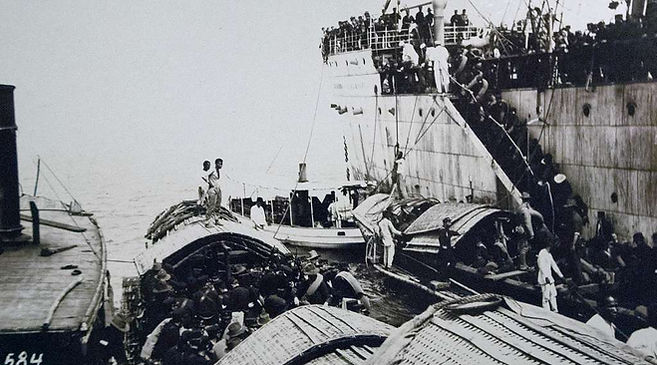
U.S. Troops disembarking from troop transport. Courtesy of the Library of Congress.
The landing force had taken Manila before we arrived. General Aguinaldo’s [1] men had been told to stand down but plenty lingered in the suburbs and some stayed in the city itself. For a while the diplomats managed to keep open war from breaking out between us and the Filipinos—with only one thing certain: we weren’t going home.
Anchored off Cavite we spent days unloading ton after ton of cargo onto flat-bottom boats, then towing them ashore behind steam launches. From there it was all backbreaking labor—dragging it through mud and heat into crooked warehouses. Tropical rain fell like insult; when the sun broke through, it punished us harder still. Whatever strength we had left seemed to leak out one day at a time. By then most of us were malcontents—sick, bitter and wishing we’d never enlisted.
All around us the signs of so-called civilization were in decay after Dewey’s bombardment. Our next duty was to clean it up: rubble, garbage and sewage. We were meant to bring the “benefits of America” to the islands but most days we could barely crawl out of our tents, let alone haul a nation into order. The air was thick enough to drink. When it rained it drowned us; when it didn’t, the heat blistered our lungs.
A volunteer made thirteen dollars a month. When I went absent without leave from September 23 to 25, they docked me four dollars. Best money I ever spent. For three days I walked away from the heat, the filth and orders. I came back when I had to—what choice did I have?—but I’d made my point to myself, if to no one else.
After that, my body did the deserting for me. The last days of September I was too sick to report for duty and by October 4th I was in the field hospital with acute diarrhea. [2]
General Aguinaldo’s men had been told to stand down, but plenty lingered in the suburbs and the city itself. For a while diplomats managed to keep open war from breaking out between us and the Filipinos but one thing was certain: we weren’t going home. After three hundred years of colonization, that is what Aguinaldo and his army wanted most.
Still, the work went on. The army restored the city’s lighting and water systems. Schools reopened and some soldiers became teachers. Roads and bridges were rebuilt. Outposts were manned. Skirmishes with Filipino forces broke out from time to time and were put down. But mostly—if you weren’t sick—you were bored.
We were under the command of General Otis [3] who wanted us disciplined as regulars but fed and treated us worse than our mules. He may have looked fine on paper, maybe, but ask any man in the mud of Cavite what they thought of him and you’d get an earful. We called him Granny Otis. He wrote home to Washington saying all was well while half of us were shitting ourselves to death. A commander who thinks appearances matter more than his men—well, that’s no commander at all. He tried his best at worse to whip us into a disciplined army while our government-issued clothing rotted. Typhoid fever, malaria, dysentery, tuberculosis, smallpox and pneumonia tore through the ranks. The Filipino soldiers fared no better.
On November 28 at muster,[4] I lost another dollar and a half for some trouble I’d gotten into. I was drinking hard then—and never alone. Eventually, Phil Greenan put me straight and I sobered up.
What we didn’t know at the time was that President McKinley had already sent orders to his men in Paris: the United States would claim the Philippines. The thinking in Washington was that it was our duty to take the islands and Emilio Aguinaldo wasn’t having it. He wasn’t some backwoods bandit. He called himself President of the Philippine Republic and his men followed him the way Washington’s had once followed him in our own revolution. We called him a rebel general but to his people he was El Presidente—the man who had broken Spain’s grip in the provinces. I can’t say we cared much for him, but we knew his name and knew he had an army. The Filipinos wanted independence and Aguinaldo turned his men against us.
The war with Spain was finished but we were bracing for another fight. This time however, against the very people we’d just liberated from Spanish rule. Most of us were more afraid of disease than a Filipino bullet. The choice to soldier on wasn’t ours to make. We were made to take orders. If our anger couldn’t be spent on Spain, the Filipinos would do. We didn’t care for them; they didn’t care for us.
When the Treaty of Paris was signed in December 1898,[5] Cuba was granted its independence but not the Philippines. For twenty million dollars the islands were handed from one empire to another. Aguinaldo’s nationalists were furious. Thousands slipped past our guard posts to join their leader in the hills, armed with rifles and rage.
We weren’t going to miss out on fighting after all. Six months on the island had bled us thin but the waiting was over. A new war was at hand against an enemy that knew every trail, every village and every river crossing.
NOTES
[1] Emilio Aguinaldo (1869–1964) was the Filipino revolutionary leader who first rose against Spain in 1896 during the Katipunan revolt. After exile in Hong Kong, he returned with U.S. assistance during the Spanish-American War and proclaimed Philippine independence on June 12, 1898. Although U.S. officers initially tolerated his forces, American diplomats in Manila refused to recognize his government.
[2] James A. Callahan’s military records, can be viewed at his Gallery.
[3] Major General Elwell Stephen Otis (1838–1909) assumed command of U.S. forces in the Philippines after Dewey’s victory in Manila Bay and the sudden death of General Wesley Merritt’s replacement, General Thomas M. Anderson. Otis was a Civil War veteran and career officer, but his leadership in the Philippines was widely criticized. Soldiers dubbed him “Granny Otis” for his rigid discipline, aloof manner, and seeming indifference to their hardships. While Otis reported to Washington that “all was well” and downplayed unrest and disease, conditions in camp were dire, with epidemics of typhoid, dysentery, and malaria decimating the volunteer regiments. Many contemporaries and later historians judged Otis overly cautious, more concerned with bureaucratic control and appearances than with the welfare of his men or the political complexities of Filipino resistance.
[4] Muster day was the monthly payday ritual, when soldiers were officially “mustered” on the company rolls and issued their wages. For volunteers paid only $13 per month, it was one of the most anticipated days in camp.
[5] The Treaty of Paris was signed on December 10, 1898, officially ending the Spanish–American War. Its terms granted Cuba independence but ceded Guam and Puerto Rico to the United States. Spain also agreed to sell the Philippines to the U.S. for $20 million. Ratified by the U.S. Senate in February 1899 by a single vote over the required two-thirds majority, the treaty ignited fierce debate at home. Expansionists argued that America had a duty to hold and “civilize” the islands, while anti-imperialists—among them senators, writers and veterans of the Civil War—condemned annexation as a betrayal of republican principles. In the Philippines, the treaty marked a bitter turning point: Filipino revolutionaries who had fought against Spain now found themselves in conflict with a new colonial power.